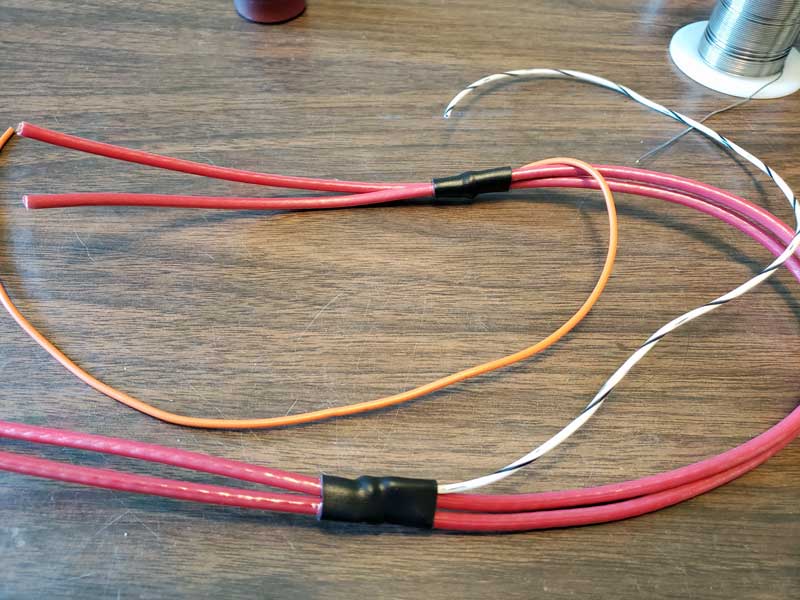
The shunt shown below has a pair of 6-inch leads out of each end; this provides enough wire to pass through ferrite cores for RF choking.
Using #10 stranded wire (THHN type recommended), cut two pieces to a length
of 24 inches each. #10 AWG is 1 milliohm per foot, so to make a 1/2 milliohm
shunt which produces 50mv full scale, two paralleled pieces with metering taps
separated by one foot are needed.
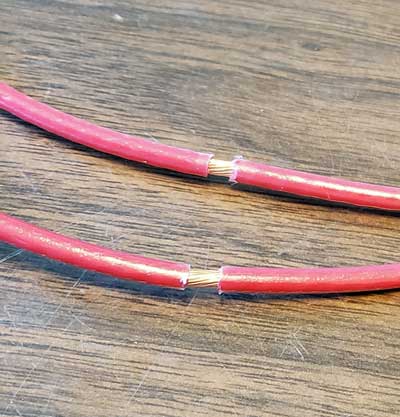 6
inches from the ends of each wire, clear away a 5mm gap of insulation to expose
the center conductor. As you can see, the wire strands are twisted clockwise
(normal), but to prepare for the next step you will need to straighten out the
twist in these spots.
6
inches from the ends of each wire, clear away a 5mm gap of insulation to expose
the center conductor. As you can see, the wire strands are twisted clockwise
(normal), but to prepare for the next step you will need to straighten out the
twist in these spots.
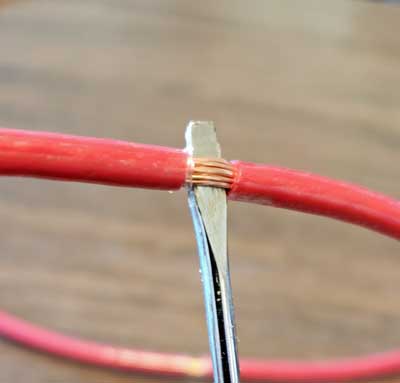 Using
a small flat-bladed screwdriver, separate the wire strands into two groups in
each gap so there will be a slot in the middle for the meter wires to pass
through
Using
a small flat-bladed screwdriver, separate the wire strands into two groups in
each gap so there will be a slot in the middle for the meter wires to pass
through
 Cut
two pieces of 18 awg wire of different colors to 18 inches in length and strip
two inches of insulation from one end of each wire (these will be the metering
taps on your shunt); pass the wire through the gaps in both of the 10awg wires
and wrap the joint tight with the excess exposed wire.
Cut
two pieces of 18 awg wire of different colors to 18 inches in length and strip
two inches of insulation from one end of each wire (these will be the metering
taps on your shunt); pass the wire through the gaps in both of the 10awg wires
and wrap the joint tight with the excess exposed wire.
Do this at both ends of this parallel-wire shunt.
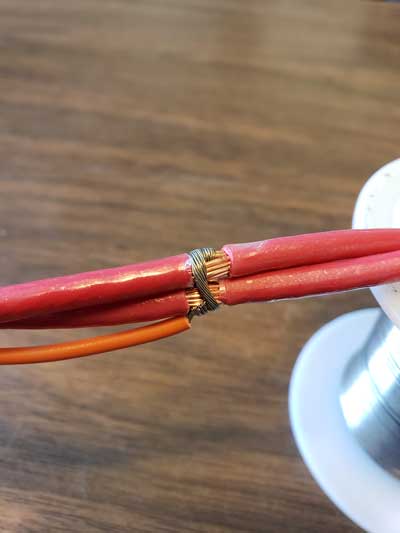
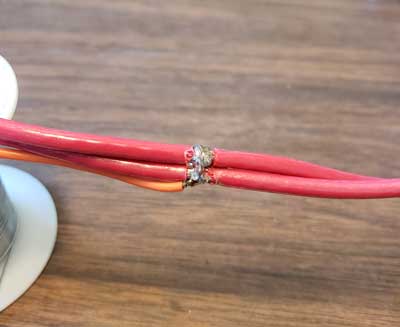 You'll
need a very hot soldering iron and some flux to solder the joints properly; all
that copper in the #10 wire sinks the heat rather quickly. Note the wire is
positioned heading toward the middle of the shunt instead of toward the end of
it.
You'll
need a very hot soldering iron and some flux to solder the joints properly; all
that copper in the #10 wire sinks the heat rather quickly. Note the wire is
positioned heading toward the middle of the shunt instead of toward the end of
it.
This joint looks a bit blobby (my lack of skill), but thankfully nobody will
be the wiser after the next step.
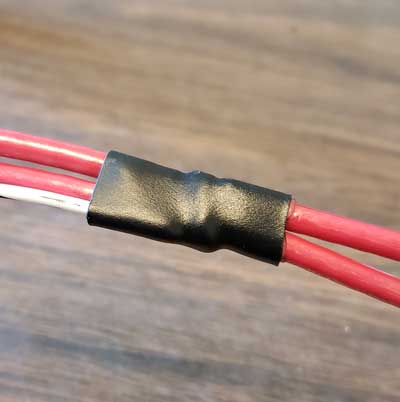 Slip
a piece of shrink tubing over each joint and shrink with your heat gun. I like
to use the kind of shrink tubing containing glue (you can see it oozing out the
end a bit). This kind of heat shrink provides excellent mechanical support for
the connection.
Slip
a piece of shrink tubing over each joint and shrink with your heat gun. I like
to use the kind of shrink tubing containing glue (you can see it oozing out the
end a bit). This kind of heat shrink provides excellent mechanical support for
the connection.
All done